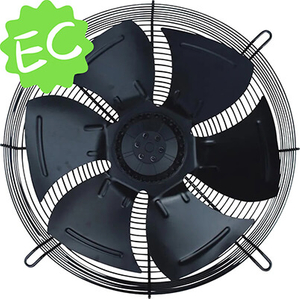
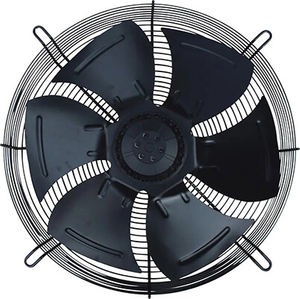
Welcome to Belmont, our main products are: axial fans, centrifugal fans, plug fans and DC/AC motors, etc. Welcome to submit your inquiry for the latest product offer.

Views: 4213 Author: Belmont Ann Publish Time: 2026-11-13 Origin: https://www.belmont-tech.com/


When a condenser fan fails or an existing cooling system needs an upgrade, choosing the right replacement fan is essential for maintaining reliable performance.
For HVAC equipment manufacturers, refrigeration system integrators, and industrial cooling operators, an EC axial fan can be an option worth evaluating. EC technology supports variable-speed operation in compatible configurations and may help reduce unnecessary energy consumption when properly matched to the application.
However, replacing a condenser fan is not simply a matter of matching the diameter or choosing a fan with a higher maximum airflow rating.
The replacement must meet the system's airflow and pressure requirements, fit the available installation space, match the electrical supply, and support the required control method.
In this guide, we explain how to select a replacement EC axial fan for a condenser, what technical information to collect, and how to evaluate potential replacement options before placing an order.
Axial fans are widely used in air-cooled condensers and other heat-rejection equipment because they move air through a relatively direct airflow path.
The fan helps move ambient air across the condenser coil, allowing heat to be transferred from the refrigerant or process fluid to the surrounding air.
When an existing fan needs replacement, the original specification may no longer be available, energy requirements may have changed, or the equipment manufacturer may want to integrate more flexible speed control.
Depending on the system requirements, an EC axial fan may offer several potential advantages.
Compatible EC axial fans can adjust their operating speed according to system demand. The available control method and operating range depend on the selected model.
Reducing unnecessary fan speed can lower electrical power consumption when the cooling system can operate effectively at a reduced airflow.
Actual energy savings depend on the fan, operating conditions, control strategy, and required cooling performance. They should be evaluated using relevant performance and power data rather than assumed from motor technology alone.
Depending on the model, control options may include 0–10V, PWM, or Modbus-RTU. These interfaces can help integrate fan operation with compatible refrigeration controllers, HVAC control systems, or building management systems.
For condenser manufacturers and OEM equipment builders, selecting an appropriate EC fan configuration may provide opportunities to optimize the fan assembly, control strategy, and electrical integration.
Before making a replacement decision, however, the first priority is to establish what the existing condenser actually requires.
The original fan's specifications provide a useful starting point for selecting a replacement.
Before contacting a manufacturer, collect as much information as possible from the existing fan nameplate, product datasheet, equipment manual, or system design documents.
Important details include:
Original fan manufacturer and model number
Impeller diameter and overall dimensions
Required airflow
Required static pressure or total pressure, as applicable
Rated voltage, phase, and frequency
Rotational speed
Rated electrical power and current
Existing speed-control method
Mounting arrangement and airflow direction
Operating temperature and environmental conditions
If the original datasheet is unavailable, photographs of the fan nameplate, mounting arrangement, electrical connections, and condenser assembly can help the manufacturer assess the replacement requirements.
It is also useful to identify why the existing fan needs replacement. A failed motor, damaged impeller, inadequate cooling capacity, excessive noise, or a planned energy-efficiency upgrade may require different considerations.
Important: The original fan's specifications are a starting point, not an automatic replacement specification. A different fan may be suitable, but the new selection must be checked against the actual system requirements.
Airflow and pressure are among the most important parameters when selecting a replacement condenser fan.
A fan's maximum airflow rating alone does not establish whether it can deliver sufficient airflow in an installed condenser.
The actual operating point depends on the fan's performance characteristics and the resistance of the complete air path.
Airflow measures the volume of air moved over a specified period.
Common units include:
m³/h: cubic meters per hour
CFM: cubic feet per minute
When comparing replacement fans from different manufacturers, make sure the airflow units are consistent.
For example, a US equipment manufacturer may specify a required airflow in CFM, while an international fan datasheet reports performance in m³/h.
Use the same operating requirement when comparing candidates.
The condenser coil, guards, nearby obstructions, and other components can affect airflow resistance.
A replacement fan must deliver the required airflow under the relevant system conditions, not merely achieve a high maximum airflow in a different test arrangement.
Also confirm whether the system requirement is stated as static pressure or total pressure. These quantities are related but are not interchangeable.
The best way to evaluate a replacement candidate is to review its manufacturer-provided performance curve.
Compare the required airflow and pressure with the fan's available performance data. Check the expected operating point and confirm that the fan is suitable for the intended operating range.
The Air Movement and Control Association's guide to fan performance curves explains the relationship between airflow, pressure, and fan operating conditions.
If you do not have the original condenser's airflow and pressure requirements, provide the manufacturer with the original fan model, equipment specifications, or available operating data so that the requirements can be assessed.
A fan that performs well on paper may still be unsuitable if it does not fit the condenser assembly.
Before finalizing a replacement, confirm the complete installation dimensions rather than checking only the nominal fan diameter.
Review the following:
Dimension or Feature | What to Check |
|---|---|
Impeller diameter | Whether the fan can fit within the available opening and clearance |
Overall fan dimensions | Width, height, depth, and any additional components |
Mounting dimensions | Hole positions, mounting points, and fixing method |
Axial clearance | Space required for the inlet and outlet airflow paths |
Fan orientation | Correct airflow direction and mounting arrangement |
Guards and accessories | Compatibility with existing guards, grilles, and mounting hardware |
Cable and connector location | Space for electrical connections and maintenance access |
A nominally similar diameter does not guarantee an exact dimensional match.
For example, a 500mm fan may have a different overall frame size, mounting pattern, blade geometry, or motor configuration from another 500mm fan.
For OEM equipment, these details are especially important because changes to the fan assembly may affect the surrounding structure, electrical layout, and production process.
Where a direct replacement is required, provide a dimensional drawing or detailed photographs to help confirm compatibility.
The replacement fan's electrical specifications must match the available power supply and the equipment's electrical design.
Check the actual supply voltage and whether the system uses single-phase or three-phase power.
For equipment deployed in the United States and Europe, supply configurations can differ between projects. Do not assume that a fan advertised for one market will automatically match the electrical requirements of another.
Confirm the specified supply frequency and ensure that the selected fan is rated for the intended electrical supply.
An EC fan's operating characteristics are determined by its motor and electronic control system, so the manufacturer's specified electrical requirements should be followed.
Review rated power input and current alongside the fan's performance requirements.
The replacement should be evaluated at the intended operating point and under the relevant environmental conditions. Electrical compatibility should also be checked against the equipment's wiring, protection, and control requirements.
Condenser applications may expose fans to elevated ambient temperatures, moisture, outdoor conditions, or other environmental stresses.
Check the selected model's permitted operating temperature, ingress protection rating, insulation and electrical specifications, and any additional project requirements.
The appropriate requirements depend on the installation location and applicable regulations.
The replacement fan should work with the intended control architecture.
Depending on the selected EC axial fan model, available control options may include 0–10V analog control, PWM, or Modbus-RTU communication.
A compatible controller sends an analog signal to adjust the fan's operating speed according to system demand.
This may be suitable when the condenser control system already provides a compatible analog output.
Pulse-width modulation may be available on supported fan models and controllers. Confirm the signal requirements and electrical interface before specifying the replacement.
Compatible Modbus-enabled EC fans may support digital commands and selected monitoring functions. The actual available parameters depend on the fan's implementation and documentation.
Before ordering, confirm:
Which control method the existing condenser uses
Whether the replacement supports that interface
The required signal range or communication settings
The available minimum and maximum operating speeds
Whether monitoring, alarm outputs, or actual RPM feedback are required
What the fan does when a control signal or communication connection is lost
Do not assume that all EC axial fans support every control interface or that two different control systems are automatically compatible.
For more technical details, read our guide to 0–10V vs. Modbus-RTU Control for EC Axial Fans once the article has been published at that URL.
A replacement project is an opportunity to review the overall performance of the condenser, rather than simply restoring the original fan.
For commercial HVAC equipment, refrigeration installations near occupied areas, and noise-sensitive locations, acoustic performance may be an important selection criterion.
Compare the available noise data using consistent measurement conditions and definitions. Sound power and sound pressure are different quantities, so their values should not be compared directly without understanding the measurement basis.
Evaluate power consumption under the expected operating conditions.
A fan that offers variable-speed control may reduce energy use when the system can meet its cooling requirements at a lower speed. However, energy savings depend on actual operating conditions and control strategy.
When comparing candidates, use performance curves and power data to ensure that both candidates are being evaluated against the same airflow and pressure requirements.
Consider the condenser's operating environment, including ambient temperature, moisture, dust, corrosion exposure, and potential water ingress.
Check that the selected fan's specified operating range, protection rating, materials, and mounting arrangement are suitable for the installation.
For demanding environments, discuss any special requirements with the manufacturer before selecting the final configuration.
Belmont Fan lists the following product for condenser-related applications:
Model: BEFEC137-A500-001
View the Belmont 500mm Low-Noise 3-Phase EC Axial Fan for Condenser
Selected published specifications include:
Parameter | Published Specification |
|---|---|
Nominal fan diameter | 500mm |
Rated voltage | 380/400V AC |
Rated speed | 1600 RPM |
Maximum listed airflow | 9,800 m³/h |
Rated power input | 950W |
Rated current | 1.6A |
Operating ambient temperature | -20°C to +60°C |
Protection rating | IP54 |
These specifications provide an initial reference for customers evaluating a 500mm EC axial fan. They do not establish that the model is a direct replacement for every existing 500mm condenser fan.
Before selecting this or another model, confirm:
The airflow and pressure required by the condenser.
Whether the fan's performance curve meets the required operating point.
The overall dimensions and mounting arrangement.
The available electrical supply and control requirements.
The ambient conditions and environmental protection requirements.
Any relevant certification or project-specific requirements.
The listed maximum airflow should not be treated as guaranteed airflow at every system pressure. The operating point must be evaluated using the manufacturer's performance data.
Several mistakes can lead to compatibility problems or poor system performance.
Two fans with the same nominal diameter may have different dimensions, airflow characteristics, speeds, or mounting requirements.
A fan's maximum airflow figure does not necessarily represent its airflow under actual condenser operating conditions.
A replacement may fail to meet the cooling system's airflow demand if its performance is not evaluated against the system resistance.
An EC fan may have the correct dimensions and rated voltage but still be unsuitable if it cannot integrate with the existing controller.
Rated power alone does not determine whether a fan is suitable. Selection should be based on the required operating point, performance curve, and complete application requirements.
Temperature, moisture, corrosion exposure, clearance, and airflow restrictions can affect the suitability of a replacement.
A systematic technical review helps reduce these risks before a purchase is made.
If you are looking for a condenser fan replacement, providing complete application information helps the manufacturer evaluate potential options.
Use the following checklist when preparing your inquiry.
Information | What to Provide |
|---|---|
Application | Air-cooled condenser, refrigeration equipment, HVAC system, or other application |
Existing fan | Manufacturer, model number, and nameplate photo |
Airflow | Required airflow in m³/h or CFM |
Pressure | Required static or total pressure, where available |
Fan dimensions | Diameter, overall dimensions, and mounting details |
Electrical supply | Voltage, phase, frequency, power, and current where known |
Control requirements | 0–10V, PWM, Modbus-RTU, or another specified interface |
Operating environment | Ambient temperature, humidity, dust, moisture, and corrosion exposure |
Performance priorities | Energy consumption, noise, variable-speed operation, or other requirements |
Quantity | Sample requirement and expected order quantity |
Project location | Country and any applicable electrical or certification requirements |
If you do not know the required airflow or pressure, do not guess. Provide the existing fan model, equipment model, nameplate details, dimensions, and application information first.
These details can help the manufacturer determine which additional measurements or documents are needed to assess a suitable replacement.
Whether you are replacing a failed fan, developing a new condenser, or evaluating an alternative for OEM production, the right selection should be based on actual system requirements.
Belmont Fan offers EC axial fan options for condenser, HVAC, refrigeration, and industrial cooling applications, with product configurations and control features depending on the selected model.
Explore the following resources:
Need help evaluating a replacement fan? Request a quotation from Belmont Fan.
When contacting our team, include your existing fan model, required airflow and pressure, installation dimensions, electrical supply, control requirements, and estimated quantity.
If you have a datasheet, performance curve, dimensional drawing, or photographs of the existing installation, include those materials in your inquiry.
Website: https://www.belmont-tech.com/
Email: sales@belmont-tech.com
Start by collecting the existing fan's model number, dimensions, electrical specifications, airflow requirements, and control interface. Then compare potential replacements against the condenser's required operating point and installation conditions.
An EC axial fan may be suitable, but the replacement must meet the airflow and pressure requirements, fit the installation, and match the electrical and control requirements. An application-specific technical assessment is recommended before making the change.
Not necessarily. Fans with the same nominal diameter can differ in overall dimensions, mounting patterns, blade geometry, motor characteristics, and performance. Confirm the complete dimensional and performance requirements before ordering.
No. The fan must provide the required airflow at the relevant system pressure. Selecting solely on maximum airflow can result in an unsuitable operating point or unnecessary energy consumption.
Provide the existing fan model, application, required airflow and pressure, dimensions, voltage, phase, frequency, control method, environmental conditions, and quantity. A nameplate photo and existing datasheet are also useful.
Many EC axial fans support variable-speed operation, but the available interface and operating range depend on the model. Confirm the control method, speed limits, and integration requirements in the manufacturer's documentation.
Selecting a replacement EC axial fan for a condenser requires more than matching the original fan's diameter or rated power. By checking the airflow, pressure, dimensions, electrical supply, control interface, and operating conditions, equipment manufacturers and system integrators can make a more informed replacement decision.
For the best results, start with the actual condenser requirements and verify that the selected fan's performance data meets the required operating conditions.