Welcome to Belmont, our main products are: axial fans, centrifugal fans, plug fans and DC/AC motors, etc. Welcome to submit your inquiry for the latest product offer.

Views: 2365 Author: Belmont Ann Publish Time: 2026-12-18 Origin: https://www.belmont-tech.com/


Refrigeration systems operate under demanding conditions. Whether used in commercial refrigeration equipment, cold storage warehouses, supermarket cooling systems, or industrial refrigeration installations, reliable airflow is essential for maintaining the required cooling performance.
The fan plays an important role in moving air across heat exchangers and supporting the overall refrigeration process.
For refrigeration equipment manufacturers and OEM buyers, selecting the right EC axial fan involves more than checking its diameter or maximum airflow.
The fan must meet the system's airflow and pressure requirements, operate within the intended temperature range, withstand moisture and environmental exposure, and integrate with the equipment's electrical and control systems.
An EC axial fan for refrigeration systems can be a suitable option when variable-speed operation, energy management, and flexible control integration are important considerations.
In this guide, we explain how to select an EC axial fan for refrigeration applications, compare different installation scenarios, and identify the technical information needed before requesting a quotation.
EC axial fans are used in different parts of refrigeration equipment, depending on the system design.
Understanding the application is the first step in selecting the correct fan.
A condenser releases heat from the refrigerant to the surrounding environment.
In air-cooled refrigeration systems, axial fans move ambient air across the condenser coil to support heat rejection.
Important fan selection factors include:
Required airflow and pressure.
Outdoor ambient temperature.
Condenser coil resistance.
Noise requirements.
Fan speed control.
Moisture and corrosion protection.
For commercial refrigeration equipment and outdoor condenser units, the fan must provide the required airflow under the actual operating conditions.
An evaporator absorbs heat from the refrigerated space.
Fans installed in cold room evaporators circulate air across the evaporator coil and distribute cooled air throughout the storage area.
Compared with condenser applications, evaporator fan selection may involve additional considerations, including:
Low-temperature operation.
Moisture and condensation.
Frost accumulation.
Defrost operating conditions.
Air distribution within the cold room.
Temperature requirements for the stored products.
The fan must be suitable for the specific evaporator design and operating environment.
Large refrigerated warehouses require consistent air circulation to support temperature distribution throughout the storage space.
Fan selection should consider the warehouse layout, airflow path, storage arrangement, required circulation rate, and potential airflow obstructions.
For larger equipment and continuous operation, reliability, maintenance requirements, and electrical energy consumption are also important considerations.
Supermarket refrigeration systems may use fans in display cabinets, refrigeration units, condensers, and other cooling equipment.
OEM manufacturers often need compact fan configurations, consistent operating performance, appropriate noise levels, and compatibility with the equipment's control system.
For these applications, the fan's mechanical dimensions and electrical connections should be reviewed early in the equipment design process.
Not every refrigeration application requires the same fan design.
Axial and centrifugal fans have different aerodynamic characteristics and are suitable for different system requirements.
An axial fan moves air approximately parallel to its rotational axis.
Its characteristics make it useful for applications requiring relatively high airflow through a compact or relatively direct airflow path.
Common refrigeration applications include:
Air-cooled condensers.
Condenser units.
Cold room ventilation and circulation equipment.
Selected evaporator and refrigeration assemblies.
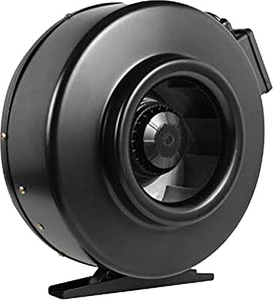
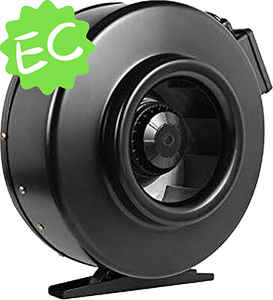
A centrifugal fan moves air through the impeller and discharges it in a direction generally perpendicular to the inlet airflow.
Depending on the design, centrifugal fans can be suitable for systems with higher airflow resistance, ductwork, or more complex air distribution requirements.
Potential applications include:
Refrigeration air distribution systems.
Selected evaporator assemblies.
Compact refrigeration equipment.
Equipment with specific pressure requirements.
Comparison | EC Axial Fan | EC Centrifugal Fan |
|---|---|---|
Airflow direction | Generally parallel to the fan axis | Generally radial to the impeller |
Typical application | Condensers and direct airflow systems | Systems with more complex airflow paths |
Airflow requirement | Often suited to relatively high-volume airflow | Depends on impeller and operating design |
Pressure requirement | Must be evaluated against the system resistance | May be suitable for higher-resistance applications |
Installation | Often integrated into panels, guards, or condenser assemblies | Often integrated into air handling or ducted assemblies |
There is no universal rule that one fan type is always better.
The final choice depends on the required airflow, pressure, installation arrangement, and complete refrigeration system design.
Belmont Fan offers both axial and centrifugal fan product categories for different airflow applications.
Explore the Belmont Fan Product Range.
Airflow is one of the most important parameters when selecting a refrigeration fan.
An undersized fan may fail to provide the required airflow, while an oversized fan may introduce unnecessary energy consumption, noise, or installation challenges.
Before selecting a fan, determine the airflow required by the refrigeration equipment.
Common airflow units include:
m³/h: cubic meters per hour.
CFM: cubic feet per minute.
m³/s: cubic meters per second.
US-based equipment manufacturers commonly use CFM, while European and international technical documentation frequently uses m³/h.
When comparing product specifications, ensure that all airflow values use consistent units.
For an air-cooled condenser, the airflow requirement depends on the heat rejection duty and the operating conditions.
Relevant considerations include:
Condenser heat rejection capacity.
Ambient air temperature.
Refrigerant operating conditions.
Coil design and surface area.
Airflow resistance.
Required condenser operating performance.
The fan should deliver sufficient airflow across the condenser coil at the required operating pressure.
For an evaporator, the airflow requirement depends on the cooling capacity, evaporator design, temperature difference, air distribution requirements, and application.
A cold room with different dimensions and storage conditions may require a different airflow arrangement from a supermarket display cabinet.
The fan selection should follow the evaporator manufacturer's design requirements rather than relying on room volume alone.
Important: There is no single airflow value that applies to all refrigeration systems. Use the equipment's design specifications and the manufacturer's engineering data to determine the correct requirement.
Airflow alone is not enough to determine whether a fan is suitable.
The fan must also overcome the resistance created by the system.
In refrigeration equipment, airflow resistance may come from:
Condenser or evaporator coils.
Protective grilles.
Filters and other air treatment components.
Ductwork and transitions.
Equipment enclosures.
Installation restrictions.
The selected fan must deliver the required airflow at the corresponding pressure.
A fan performance curve shows the relationship between airflow and pressure under specified test conditions.
When evaluating a refrigeration fan:
Identify the required airflow.
Confirm the corresponding system pressure.
Locate the required duty point.
Check the fan's performance curve at the intended operating speed.
Review the corresponding power consumption.
Do not select a fan using maximum airflow alone.
A fan advertised with a high maximum airflow may not provide the required airflow once installed in a system with significant resistance.
For more detailed guidance, read our technical article:
How to Read an EC Axial Fan Performance Curve
Once the article is published, add its final URL here to connect the two technical topics.
Low-temperature performance is an important consideration for refrigeration and cold storage applications.
Fans used in cold rooms, refrigerated warehouses, and freezer equipment may be exposed to low ambient temperatures, condensation, frost, and frequent changes in operating conditions.
Before choosing a fan, verify that the selected model is suitable for the actual installation environment.
Every EC fan has a specified operating temperature range.
Check the manufacturer's documentation for:
Minimum permissible ambient temperature.
Maximum permissible ambient temperature.
Motor operating limits.
Electronic controller operating limits.
Bearing specifications.
Permitted starting and operating conditions.
Do not assume that every EC fan can operate at the same low temperature.
Also distinguish between the temperature of the refrigerated air and the ambient temperature around the fan motor and electronic components.
For example, a fan installed in an evaporator may experience different thermal conditions across its motor, electronics, and surrounding airflow.
The exact installation conditions should be reviewed with the fan manufacturer.
Temperature changes can cause condensation around equipment components.
In refrigeration environments, moisture protection should be evaluated alongside the fan's electrical design and protection rating.
Consider:
Exposure to condensation.
Water droplets and cleaning procedures.
Cable entries and electrical connectors.
Housing and component protection.
Moisture-related corrosion risks.
Evaporator applications may involve frost accumulation and periodic defrost cycles.
The selected fan must be suitable for the equipment's operating sequence, including any required stopping, restarting, or operating restrictions during defrost.
Confirm the permitted temperature range, starting behavior, and control logic with the manufacturer.
A fan's low-temperature operating rating alone does not establish its suitability for every defrost arrangement.
Refrigeration equipment can operate in environments where moisture, cleaning chemicals, temperature variation, and condensation affect the durability of fan components.
For applications involving cold storage, commercial refrigeration, and food-related facilities, material selection and environmental protection should be reviewed carefully.
An IP rating describes the level of protection provided by an enclosure against specified ingress conditions.
Depending on the installation, an EC axial fan may require an appropriate protection rating for moisture and dust exposure.
However, an IP rating should not be treated as a complete corrosion-resistance specification.
Important components to review include:
Impeller material.
Rotor and motor housing.
Mounting frame.
Fasteners.
Bearings.
Electrical connectors.
Surface coatings.
Depending on the environment, corrosion-resistant coatings, stainless steel components, or appropriately treated aluminum may be relevant.
The exact material requirements should be determined by the installation environment and cleaning procedures.
For continuously operating refrigeration equipment, maintenance accessibility and service requirements are also important.
Review the manufacturer's bearing specifications, recommended inspection procedures, and any relevant operating limitations.
For OEM projects, it is useful to request product documentation that clearly identifies the materials and environmental ratings of the selected fan configuration.
Refrigeration systems may operate under changing cooling loads.
Using a compatible variable-speed EC axial fan can allow fan output to respond to the requirements of the system.
Depending on the fan and control configuration, available control methods may include:
0–10V analog control.
PWM control.
Modbus-RTU communication.
A compatible controller generates an analog voltage signal to adjust the fan's operating speed.
This can be suitable for refrigeration systems that require straightforward variable-speed operation.
PWM control can be used with compatible fan and controller combinations.
The exact signal characteristics and electrical interface must be confirmed in the product documentation.
For fan models that support it, Modbus-RTU can provide digital communication between the fan and a compatible controller.
Depending on the implementation, available functions may include operating commands, speed information, and selected status or fault data.
The exact functions depend on the fan's supported communication registers.
It can, when the fan is controlled appropriately and the refrigeration system can meet its requirements at a reduced speed.
However, energy consumption depends on:
Fan performance.
Required airflow and pressure.
System operating conditions.
Control strategy.
Operating hours.
Electrical input power across different speed settings.
Do not assume that every variable-speed fan will achieve the same energy savings.
For a reliable comparison, evaluate electrical power at representative operating points and compare the complete system's energy requirements.
The best fan configuration depends on the equipment in which it will operate.
For commercial refrigeration condensers, prioritize the required airflow, condenser resistance, ambient temperature, noise requirements, and electrical configuration.
If the condenser operates outdoors, consider weather exposure, moisture, dust, and corrosion protection.
A variable-speed EC fan may also be useful when the equipment requires airflow adjustment according to operating conditions.
Cold storage applications require special attention to low-temperature suitability and moisture exposure.
Check the actual ambient conditions surrounding the motor and electronic components.
For evaporator installations, confirm that the fan is compatible with the defrost cycle and the required airflow distribution.
For larger refrigerated warehouses, also consider the fan's expected operating hours, maintenance requirements, and installation arrangement.
Supermarket refrigeration equipment may operate for extended periods and may be installed in environments where noise and energy consumption are important considerations.
When selecting a fan, review:
Available installation space.
Airflow and pressure requirements.
Electrical supply.
Control interface.
Acoustic requirements.
Maintenance accessibility.
For OEM manufacturers, dimensional compatibility and electrical integration should be confirmed before mass production.
Industrial refrigeration equipment can involve demanding operating conditions and specific engineering requirements.
For these projects, fan selection should be based on complete system data rather than general product descriptions.
Provide the manufacturer with the operating temperature, airflow, pressure, electrical supply, environmental conditions, and any specific certification requirements.
Belmont Fan provides EC axial fan solutions for refrigeration and cold storage applications, including commercial condensers and other industrial cooling equipment.
The company's refrigeration application page identifies the following design considerations:
Variable-speed control through supported 0–10V or PWM interfaces.
Moisture and corrosion-related protection options.
Low-temperature application considerations.
Multiple mounting and dimensional configurations.
Available specifications depend on the selected model and application.
Explore the Belmont Refrigeration and Cold Storage Solutions.
Model: BEFEC137-A630-KA1
Belmont lists the following specifications:
Parameter | Published Specification |
|---|---|
Fan diameter | 630mm |
Rated voltage | 380/440 VAC |
Supply frequency | 50/60 Hz |
Rated speed | 1250 RPM |
Maximum listed airflow | 14,634 m³/h |
Power input | 1000W |
Rated current | 1.81A |
Permissible ambient temperature | -20°C to +60°C |
Protection class | IP54 |
Blade material | Carbon steel |
Number of blades | 5 |
The product page also lists 0–10V/PWM and Modbus-related speed-control options, subject to the actual model configuration.
View the 630mm 3 Phase Low-Noise EC Axial Fan for Refrigeration Unit
Model: BEFEC137-A710-KA1
Belmont lists the following specifications:
Parameter | Published Specification |
|---|---|
Fan diameter | 710mm |
Rated voltage | 380/400 VAC |
Supply frequency | 50/60 Hz |
Rated speed | 930 RPM |
Maximum listed airflow | 14,730 m³/h |
Power input | 700W |
Rated current | 1.2A |
Permissible ambient temperature | -20°C to +60°C |
Protection class | IP54 |
Blade material | Carbon steel |
Number of blades | 7 |
The product page also provides performance curves and dimensional drawings for technical evaluation.
View the 710mm Low-Noise Carbon Steel EC Axial Fan for Refrigeration
Important: These published specifications are reference information, not proof of direct interchangeability. Verify the latest datasheet, performance curve, allowable operating conditions, and control configuration before specifying either model.
The listed ambient temperature range must also be checked against the actual environment around the fan and its electronics. Do not assume that an individual model with a -20°C listed limit is automatically suitable for every freezer or -30°C application.
For refrigeration OEMs and equipment manufacturers, providing complete application information helps the fan supplier evaluate the appropriate configuration.
Before requesting a quotation, prepare the following details:
Parameter | Information to Provide |
|---|---|
Application | Condenser, evaporator, cold room, supermarket refrigeration, or warehouse |
Required airflow | m³/h or CFM |
Required pressure | Static or total pressure, where applicable |
Fan diameter | Required diameter and available installation dimensions |
Electrical supply | Voltage, phase, and frequency |
Operating temperature | Minimum and maximum ambient conditions around the fan |
Control method | 0–10V, PWM, Modbus-RTU, or another requirement |
Environmental conditions | Moisture, condensation, frost, dust, cleaning chemicals, and corrosion exposure |
Defrost requirements | Whether the application involves defrost cycles and any fan operating restrictions |
Noise requirements | Maximum permitted noise level and measurement conditions |
Installation | Mounting method, airflow direction, and available space |
Quantity | Sample quantity and estimated production order |
Certification | Applicable project and market requirements |
If you are replacing an existing fan, provide the original model number, product nameplate photograph, installation drawing, and available performance data.
If the airflow or pressure requirements are not available, share the refrigeration equipment specifications first so that the fan supplier can identify the missing technical information.
Avoid these common mistakes when sourcing a fan for refrigeration equipment.
Two fans with the same diameter may have different airflow, pressure, motor characteristics, dimensions, and mounting arrangements.
A fan's permissible ambient temperature must be suitable for the actual installation conditions.
Check the motor and electronics specifications rather than assuming that all EC fans are designed for the same low-temperature environment.
Moisture exposure and frost-related operating conditions can affect fan suitability.
Review the equipment's environmental conditions and defrost sequence before making a selection.
A fan may have a high free-air rating but still fail to deliver the required airflow under the installed operating conditions.
Always check the performance curve.
Control interfaces and monitoring features vary by model.
Confirm the available functions and controller compatibility before ordering.
For equipment designed for long-duration operation, power consumption, maintenance requirements, operating conditions, and product suitability should all be considered in the purchasing decision.
A complete technical comparison is more useful than comparing fan prices alone.
Selecting the right EC axial fan for a refrigeration system requires matching the fan's performance, operating temperature, electrical supply, control interface, and environmental protection to the actual equipment requirements.
Whether you are manufacturing commercial refrigeration units, designing cold storage equipment, producing condenser assemblies, or sourcing fans for OEM production, Belmont Fan can review your application requirements and available specifications.
Looking for an EC axial fan for refrigeration or cold storage?
Contact Belmont Fan with the following information:
Application and equipment type.
Required airflow and pressure.
Fan diameter and installation dimensions.
Electrical supply.
Operating temperature range.
Required speed-control interface.
Environmental conditions.
Sample and production quantities.
If you have an existing fan datasheet, nameplate photograph, or technical drawing, include it in your inquiry.
Explore Belmont Refrigeration and Cold Storage Solutions:
https://www.belmont-fan.com/Refrigeration-and-Cold-Storage.html
Request a Quote:
Website: https://www.belmont-fan.com/
Email: sales@belmont-tech.com
EC axial fans can be used in air-cooled condensers, selected evaporator assemblies, refrigeration equipment, and cold storage ventilation applications, depending on their design and performance characteristics.
Some EC axial fan models are designed for low-temperature applications. However, the permitted temperature range varies by model. Always check the motor, electronic controller, bearing, and starting-condition specifications against the actual installation environment.
A condenser fan moves ambient air across the condenser heat exchanger to support heat rejection. An evaporator fan circulates refrigerated air across the evaporator and distributes cooled air within the intended space. Their airflow, temperature, moisture, and control requirements can differ.
They can be suitable when the selected model meets the condenser's airflow, pressure, electrical, control, and environmental requirements. A performance curve should be used to verify the operating point.
An axial fan moves air primarily along its rotational axis and is commonly used in direct airflow applications. A centrifugal fan moves air radially through its impeller and may be suitable for systems with different pressure or air distribution requirements. The correct choice depends on the equipment design.
Many EC fans support variable-speed operation through compatible control inputs or communication interfaces. Depending on the model, options may include 0–10V, PWM, and Modbus-RTU. Confirm the actual available features before ordering.
Provide the application, required airflow and pressure, fan dimensions, electrical supply, operating temperature, control method, environmental conditions, and quantity. An existing fan model or datasheet is also useful.
Choosing the right EC axial fan for refrigeration systems requires a complete understanding of the equipment's operating conditions. By evaluating airflow, pressure, low-temperature suitability, moisture protection, control compatibility, and installation requirements together, refrigeration equipment manufacturers and OEM buyers can make a more informed purchasing decision.